

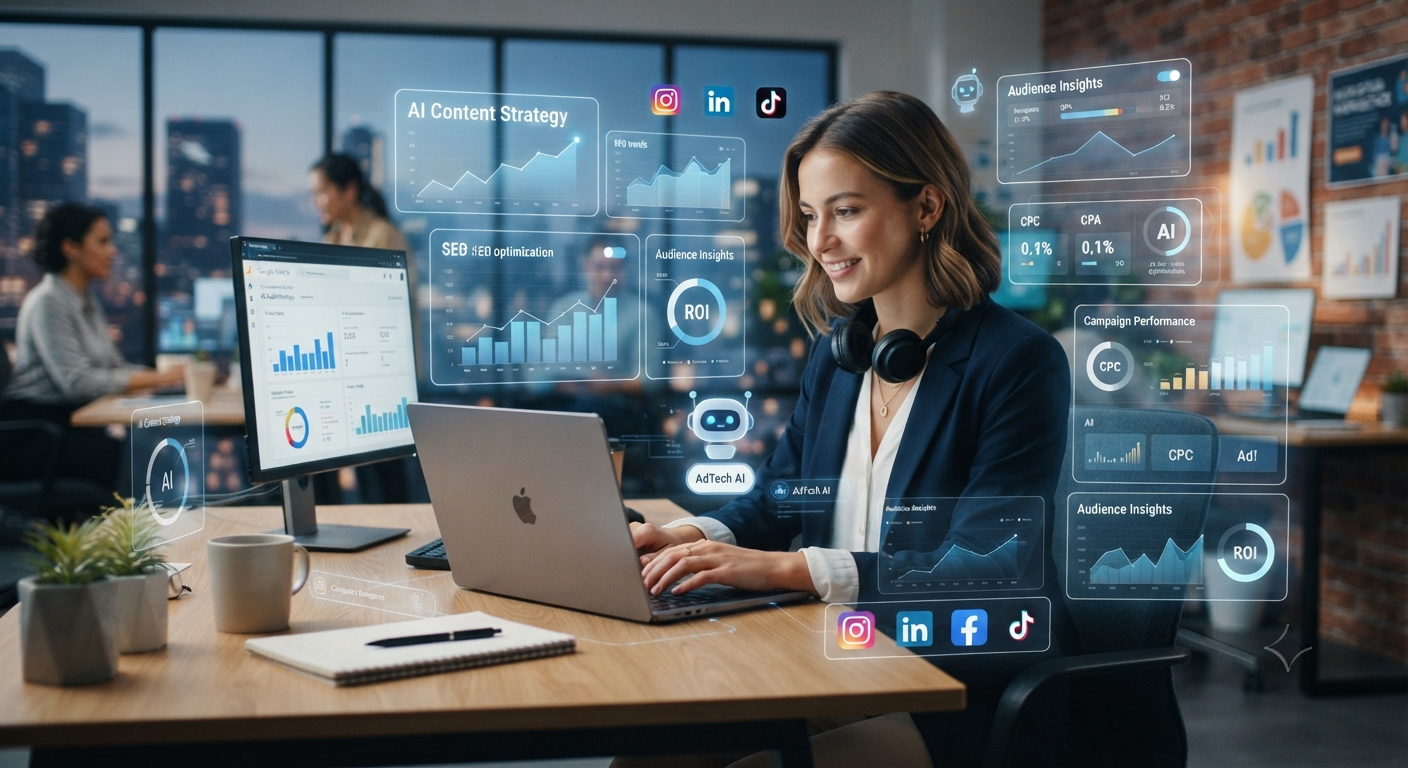
Artificial intelligence (AI) is no longer just a futuristic technology. It has quickly become part of everyday digital marketing. From creating content and analyzing customer behavior to improving advertisements and personalizing online experiences, AI is changing how brands connect with their audiences.
For marketers, this change brings both opportunities and challenges. Tasks that once required hours of manual work can now be completed much faster with the help of AI-powered tools. At the same time, marketers still need human creativity, strategy and judgment to use these tools effectively.
So, how exactly is AI changing digital marketing in 2026? Let’s explore.
What Is AI in Digital Marketing?
AI in digital marketing refers to using artificial intelligence technologies to understand data, identify patterns, automate tasks and help marketers make better decisions.
Instead of relying entirely on manual research and repetitive tasks, marketers can use AI to analyze large amounts of information and generate useful insights.
For example, AI can help a marketer:
- Find content ideas
- Understand search intent
- Analyze customer behavior
- Create content drafts
- Personalize marketing messages
- Optimize advertising campaigns
- Answer customer questions through chatbots
- Analyze campaign performance
AI is therefore becoming less of a simple automation tool and more of a marketing assistant.
7 Ways AI Is Changing Digital Marketing
1. AI Is Making Content Creation Faster
Creating quality content consistently can be time-consuming. Marketers have to research topics, develop ideas, write copy, create social media posts and prepare email campaigns.
AI tools can help speed up many of these processes.
A marketer can use AI to brainstorm blog topics, create content outlines, generate headline ideas, summarize information or create first drafts.
However, AI-generated content should not simply be published without human review. Marketers still need to check facts, add original insights and make sure the content matches the brand’s voice.
The future isn’t necessarily AI-written content. It’s AI-assisted content with human creativity behind it.
2. AI Is Changing SEO
Search engine optimization is also becoming more closely connected with AI.
AI can help marketers understand keywords, search intent, content gaps and relationships between different topics. It can also help analyze existing content and identify opportunities for improvement.
Search itself is changing too. Google has continued introducing AI-powered experiences that allow people to explore information in more conversational ways.
For SEO professionals, this means focusing only on inserting keywords is no longer enough.
Successful SEO increasingly requires:
- Helpful and relevant content
- Strong topical coverage
- Clear answers to user questions
- Good website experience
- Original insights
- Trustworthy information
In other words, marketers need to optimize for people and search experiences, rather than simply optimizing for keywords.
3. AI Is Personalizing Customer Experiences
Have you ever visited an online store and received product recommendations based on what you previously viewed?
That’s an example of personalization.
AI can analyze customer behavior and help businesses understand what different audiences may be interested in.
Brands can use these insights to personalize:
- Product recommendations
- Email campaigns
- Website experiences
- Offers
- Advertisements
- Content recommendations
Personalization can make marketing messages more relevant instead of showing exactly the same message to everyone.
4. AI Is Transforming Digital Advertising
Advertising is another area where AI is having a major impact.
Modern advertising platforms increasingly use AI to help marketers find audiences, optimize campaigns, create assets and improve performance.
Google, for example, has introduced AI-powered advertising features including AI Max for Search campaigns and new AI-driven creative and campaign-management tools.
In 2026, Google is also introducing new AI-powered experiences across Search and YouTube, including tools designed to help businesses with discovery, creative production and campaign measurement.
This doesn’t mean marketers can simply turn on AI and forget about their campaigns.
Instead, marketers need to provide good inputs, clear goals, accurate business information and appropriate brand guidelines.
5. AI Is Making Social Media Marketing Smarter
Social media marketers have to constantly come up with new content ideas and understand what their audiences want.
AI can assist with:
- Social media content ideas
- Caption creation
- Content calendars
- Audience analysis
- Trend research
- Performance analysis
- Creative variations
For example, a marketer could use AI to generate several caption ideas for the same Instagram post and then adapt the best one to match the brand’s personality.
But social media is ultimately about people.
A completely automated social media presence can feel robotic. Human storytelling, humor, opinions and community interaction are still essential.
6. AI Is Improving Customer Support
AI-powered chatbots are changing the way businesses communicate with customers.
Instead of waiting for a customer-service representative to respond, customers can get answers to common questions at any time.
Businesses can use AI assistants to help with:
- Frequently asked questions
- Product information
- Order-related queries
- Appointment scheduling
- Basic troubleshooting
- Lead qualification
Google’s 2026 marketing developments also include AI-powered conversational experiences designed to help businesses interact with potential customers directly.
The key is knowing when AI should handle a conversation and when a human should take over.
7. AI Is Helping Marketers Make Better Decisions
Digital marketing produces enormous amounts of data.
Website visits, clicks, conversions, engagement, customer behavior and advertising performance can be difficult to analyze manually.
AI can help marketers identify patterns and turn large amounts of data into useful insights.
For example, AI-powered marketing platforms can help identify:
- Which campaigns are performing well
- Which audiences are most engaged
- Which content receives the most attention
- Where customers drop out of the buying journey
- Where marketing budgets could be improved
Google is also expanding AI capabilities across Ads and Analytics to help marketers uncover insights and act on them more quickly.
Benefits of AI in Digital Marketing
When used correctly, AI can provide several benefits.
Saves Time
AI can automate repetitive tasks and help marketers complete research and content-related tasks faster.
Improves Productivity
Instead of spending hours on basic tasks, marketers can spend more time on strategy and creative thinking.
Supports Personalization
AI can help businesses deliver more relevant experiences to different customer groups.
Helps With Data Analysis
AI can process large amounts of information and identify patterns that may be difficult to notice manually.
Helps Small Businesses
Small businesses with limited marketing teams can use AI tools to support content, advertising, research and customer communication.
Challenges of Using AI in Digital Marketing
AI is powerful, but it isn’t perfect.
Accuracy
AI can sometimes produce incorrect or outdated information. Important facts should always be verified before publishing.
Generic Content
If everyone uses AI in exactly the same way, content can become repetitive and unoriginal.
Privacy
Businesses need to be careful about how customer data is collected, stored and used.
Overdependence on AI
AI should support marketers rather than replace their judgment.
Transparency
As AI-generated advertising and content become more common, transparency is becoming increasingly important. Google, for example, has introduced additional transparency features to help people understand when generative AI was used to create or modify advertisements.
Will AI Replace Digital Marketers?
This is probably one of the biggest questions beginners have.
The simple answer is: AI is more likely to change the role of marketers than completely replace them.
AI can analyze data, generate ideas and automate repetitive tasks, but marketing still requires human understanding.
A successful marketer needs to understand:
- What customers actually want
- How to communicate emotionally
- How to build a brand
- How to develop a strategy
- How to make ethical decisions
- How to tell a compelling story
AI can provide assistance, but humans still provide direction.
That’s why learning digital marketing + AI can be a valuable combination for beginners.
What Should Digital Marketing Beginners Learn?
If you’re starting your digital marketing journey in 2026, don’t focus on learning just one AI tool.
Instead, build a strong foundation in:
- SEO
- Content marketing
- Social media marketing
- Googlhttps://blog.google/products/ads-commerce/dsa-upgrade-to-ai-max-2026/?utm_source=chatgpt.come Ads
- Analytics
- Email marketing
- AI tools
- Copywriting
- Customer psychology
- Marketing strategy
Then learn how AI can make each of these areas more efficient.
The Future of AI in Digital Marketing
The future of marketing is likely to become increasingly AI-assisted.
Search engines are becoming more conversational. Advertising platforms are becoming more automated. Businesses are using AI to understand customers, create marketing assets and analyze performance.
At the same time, marketers will need to become better at providing strategy, creativity and direction.
The biggest advantage may not belong to people who use AI the most. It may belong to people who know when, where and how to use AI effectively.
Final Thoughts
AI is changing digital marketing from content creation and SEO to advertising, personalization, customer support and analytics.
But AI isn’t the end of human marketing.
It’s a new tool that gives marketers the opportunity to work faster, experiment more and focus on higher-value activities.
For beginners, this is actually exciting. You don’t need to become an AI expert overnight. Start by understanding the fundamentals of digital marketing and gradually learn how AI can improve your workflow.
The future of digital marketing isn’t simply human vs. AI. It’s humans using AI intelligently.
If you’re beginning your digital marketing journey, now is a great time to start learning, experimenting and building your own skills.
Suggested CTA
Want to learn more about digital marketing? Explore more beginner-friendly guides on SEO, social media marketing, Google Ads and AI-powered marketing strategies on our website.